Ferroelectric Switching of HfO₂ along the S:T Pathway (Energy Barrier)
1. Introduction
This tutorial calculates the energy barrier of the uniform polarization reversal of bulk orthorhombic Pca2₁ HfO₂ along the S:T pathway, reproducing a result from the following manuscript:
Manuscript
X. Mu, Y. Wu, B. Zeng, J. Jiang, Y. Zhou, L. Yin, M. Liao and Q. Yang, "Polarization switching of HfO2 ferroelectric in bulk and electrode/ferroelectric/electrode heterostructure", npj Computational Materials 11, 126 (2025). DOI: 10.1038/s41524-025-01633-2. 1
This tutorial builds upon the Ferroelectric Switching of HfO₂ along the S:T Pathway tutorial, where the initial structure and the structure with the four three-fold coordinated O shifted through the Hf plane are created. Here, both are relaxed with the cell fixed, and a climbing-image nudged elastic band (NEB) calculation runs between them on the platform. The barrier is compared with Table 1 of the manuscript.
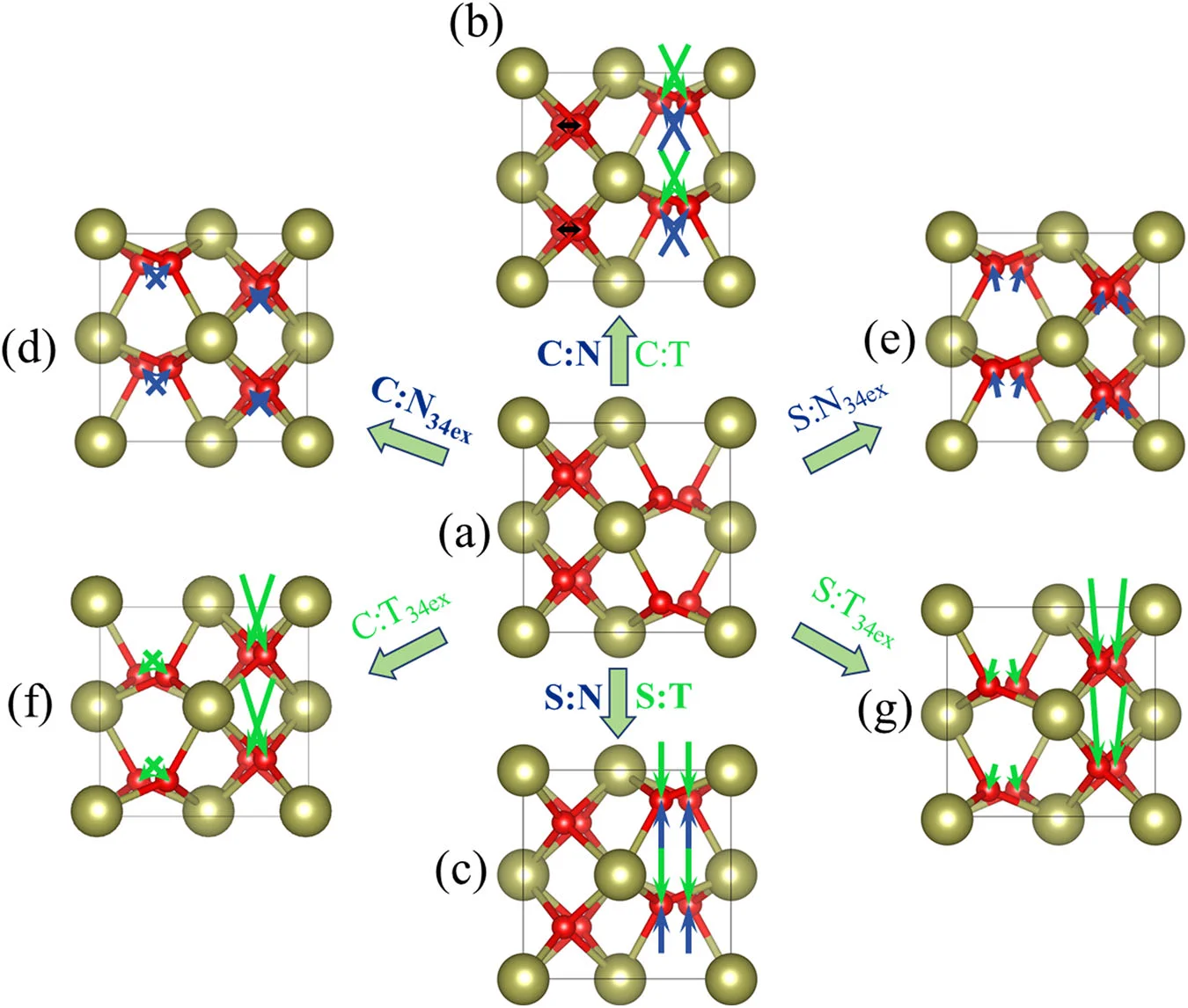
The figure below shows Fig. 1 of the manuscript; the path computed here is S:T, from the initial state (a) to the final state (c):
2. Prerequisites
Before starting this tutorial, one of the following steps should be completed:
- Follow the Ferroelectric Switching of HfO₂ along the S:T Pathway
tutorial, using the
perturbation_ferroelectric_switching_hafnium_dioxide.ipynbnotebook embedded in its section 6, to create and saveHfO2 Pca21andHfO2 Pca21 S:T switched, OR - Have the two materials saved in the
uploadsfolder or in the account's materials collection
3. Workflow overview
The barrier calculation consists of the following steps:
- Set up the environment and parameters: Configure material names, the Density Functional Theory (DFT) model, and compute resources
- Authenticate and initialize API client: Connect to the platform
- Load materials: Import the two materials by name and print their atom counts
- Configure the model: One DFT model for the relaxations and the NEB
- Configure compute resources: Select the cluster, queue, nodes, and processor settings
- Relax the end points: Both materials are relaxed on the platform with the cell fixed
- Run the nudged elastic band: One climbing-image NEB runs between the two relaxed materials
- Retrieve results: The NEB energy profile, the barrier, and the largest image error
- Compare with the manuscript: Print the barrier beside Table 1's and plot the profile
4. Calculation parameters
The manuscript takes the bulk barrier of Table 1 from Wu et al. 2023 (its ref. 24) 2 and does not restate the settings behind it; the right column lists the manuscript's own settings (Methods, p. 6).
| This tutorial | Mu et al., Methods | |
|---|---|---|
| Code | Quantum ESPRESSO 7.5, on the platform | VASP |
| Functional | Perdew–Burke–Ernzerhof (PBE) | PBE |
| Pseudopotentials | ultrasoft, Garrity–Bennett–Rabe–Vanderbilt (GBRV) library: hf_pbe_gbrv_1.0 (5s 5p semicore, 12 electrons) and o_pbe_gbrv_1.2 |
projector augmented-wave (PAW) |
| Cutoff | 40 / 200 Ry | 500 eV |
| k-points | 6 × 6 × 6 Monkhorst–Pack, shifted by half a step (1 1 1) |
6 × 6 × 6 Monkhorst–Pack |
| Spin, smearing | not spin-polarized, 0.005 Ry | not stated |
| Cell | unit cell, 4 Hf and 8 O, fixed: 5.2195 × 5.0048 × 5.0327 Å (Standata, mp-685097) | unit cell, 4 Hf and 8 O (Table 1, p. 4), fixed: 5.256 × 5.046 × 5.073 Å |
| End points | relaxed, all atoms, cell fixed | not stated |
| Transition state | climbing image, one intermediate image, path threshold 0.1 eV/Å | climbing-image NEB, number of images not stated |
A material already relaxed with the same KGRID, or still relaxing, is reused, and so is an NEB job of the same path
from the same initial material that is queued, running or finished with the same KGRID, also when the application
version or a setting of cell 1.4, N_IMAGES included, has changed.
5. Step-by-step instructions
5.1. Open the notebook
Navigate to the API examples repository and open the barrier notebook:
1 | |
5.2. Configure parameters
The parameters cells of section 1 set the material names, the manuscript's barrier, the compute resources, and the DFT model:
1 2 3 4 5 6 7 8 9 10 11 12 13 14 15 16 17 18 19 20 21 22 23 | |
5.3. Run the notebook
Execute all cells by selecting Run > Run All Cells from the menu.
The notebook first authenticates with the platform, then runs the steps listed in section 3.
5.4. Monitor progress
The notebook submits the two relaxations, then the NEB, and polls each job on the platform until it finishes.
5.5. Analyze results
The last cells print the barrier beside the manuscript's value, with the largest image error of the final path, and plot the energy profile:
1 2 | |
6. Expected results
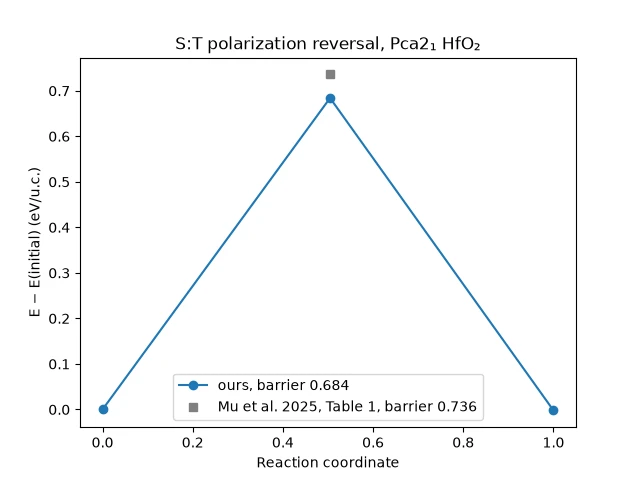
Table 1 of the manuscript (p. 4) gives the barrier of the uniform polarization reversal along the S:T pathway in bulk, with the cell fixed, as 0.736 eV per unit cell of four Hf and eight O atoms (u.c.).
6.1. Comparison with published results
| Mu et al., Table 1 | This tutorial | |
|---|---|---|
| S:T barrier, bulk, fixed cell | 0.736 eV/u.c. (from Wu et al. 2023) | 0.684 eV/u.c. |
The figure below shows the energy profile of the NEB computed here, with the manuscript's barrier as a gray square at the reaction coordinate of the highest image:
6.2. Difference from the manuscript
These settings differ:
| Setting | Mu et al. | This tutorial | Parameter to change |
|---|---|---|---|
| Code, pseudopotentials | VASP, PAW (p. 6) | Quantum ESPRESSO, GBRV ultrasoft | — |
| Cutoff | 500 eV (p. 6) | 40 / 200 Ry | ECUTWFC, ECUTRHO |
| Lattice | 5.256 × 5.046 × 5.073 Å, the manuscript's PBE calculation (p. 6) | 5.2195 × 5.0048 × 5.0327 Å, Standata mp-685097 | — |
| Smearing | not stated | 0.005 Ry | degauss in QE_SYSTEM_SETTINGS |
| Intermediate images | not stated | one | N_IMAGES |
7. Interactive JupyterLite notebook
The following JupyterLite notebook demonstrates the workflow for calculating the S:T polarization switching barrier of Pca2₁ HfO₂. Select Run > Run All Cells.
8. References
-
Xinpeng Mu, Yao Wu, Binjian Zeng, Jie Jiang, Yichun Zhou, Lu Yin, Min Liao, and Qiong Yang. Polarization switching of HfO2 ferroelectric in bulk and electrode/ferroelectric/electrode heterostructure. npj Computational Materials, 11(1):126, 2025. URL: https://doi.org/10.1038/s41524-025-01633-2. ↩
-
Yao Wu, Yuke Zhang, Jie Jiang, Limei Jiang, Minghua Tang, Yichun Zhou, Min Liao, Qiong Yang, and Evgeny Y. Tsymbal. Unconventional polarization-switching mechanism in (Hf,Zr)O2 ferroelectrics and its implications. Physical Review Letters, 131(22):226802, 2023. URL: https://doi.org/10.1103/PhysRevLett.131.226802. ↩